

Formula 1’s Sponsorship Model Assumes Racing is Fair
When the Safety Car comes out, the sport’s sponsorship assumptions go with it


Welcome to the first edition of The Apex, a new newsletter from Autosport Business about the money, incentives, and hidden pressures shaping Formula 1.
The Assumption
Formula 1 sells itself as a meritocracy.
Over a single race, it is not.
The fastest car should win. The finishing order should reflect how each car performed over the race distance.
That assumption holds often enough to feel reliable, but it does not hold in every race.
The sport produces results that diverge from the underlying pace of the cars involved. A faster car can control most of a race and still lose it. A midfield team can inherit a win. The finishing order becomes fixed even when the race itself suggested something different.
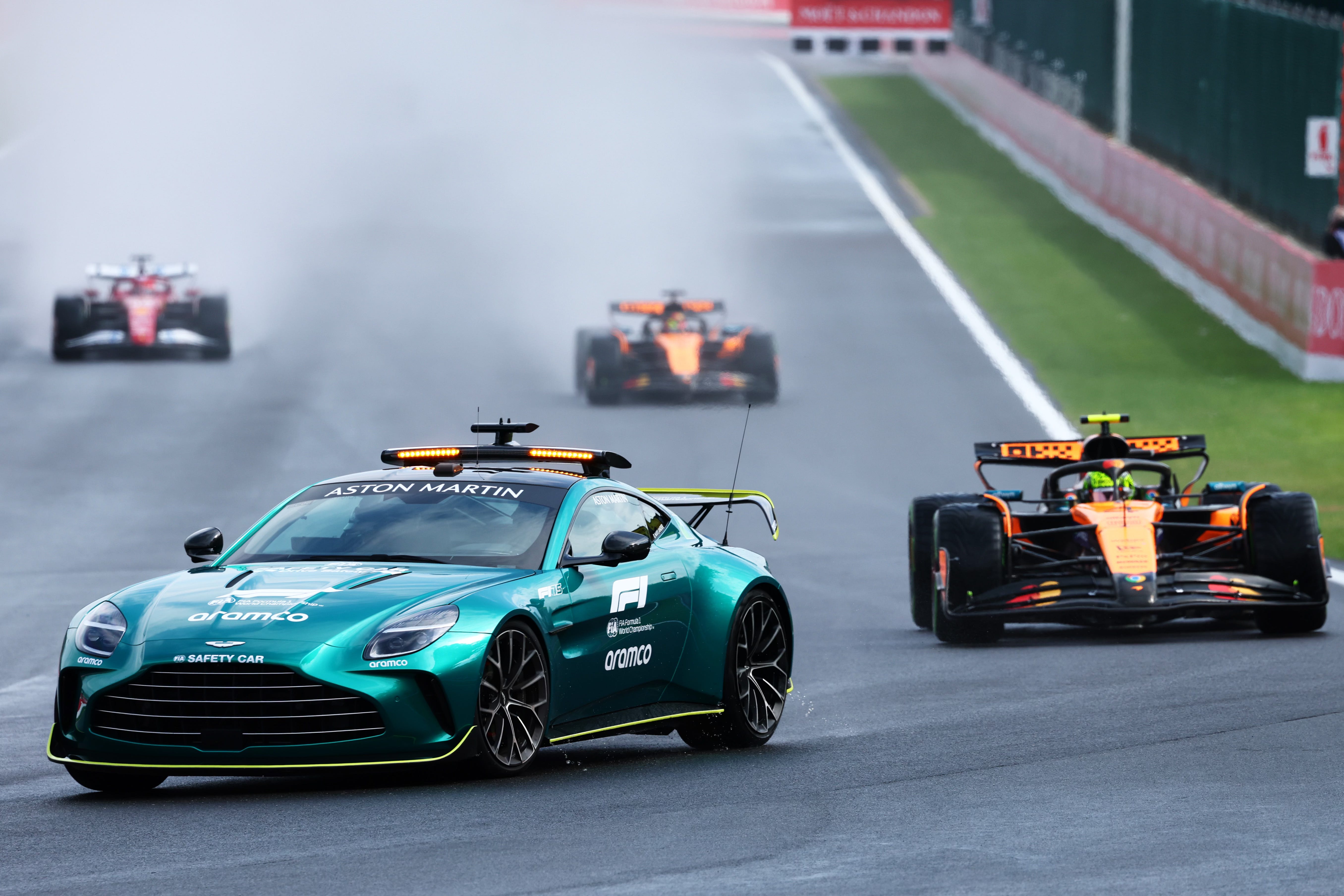
At the 2020 Italian Grand Prix, a red flag and pit lane closure inverted the running order. Cars that had controlled the race lost positions they had already earned. A midfield driver inherited the lead and held it to the finish. It stands in the record as a win.
This is part of how a Formula 1 race functions
The Mechanism
The gap between performance and result opens through several mechanisms within a race. Strategy timing, tire life, track position, and events such as Safety Cars, Virtual Safety Cars, and red flags all influence where a car finishes relative to its pace.
A Safety Car removes the gaps built through pace and compresses the field.
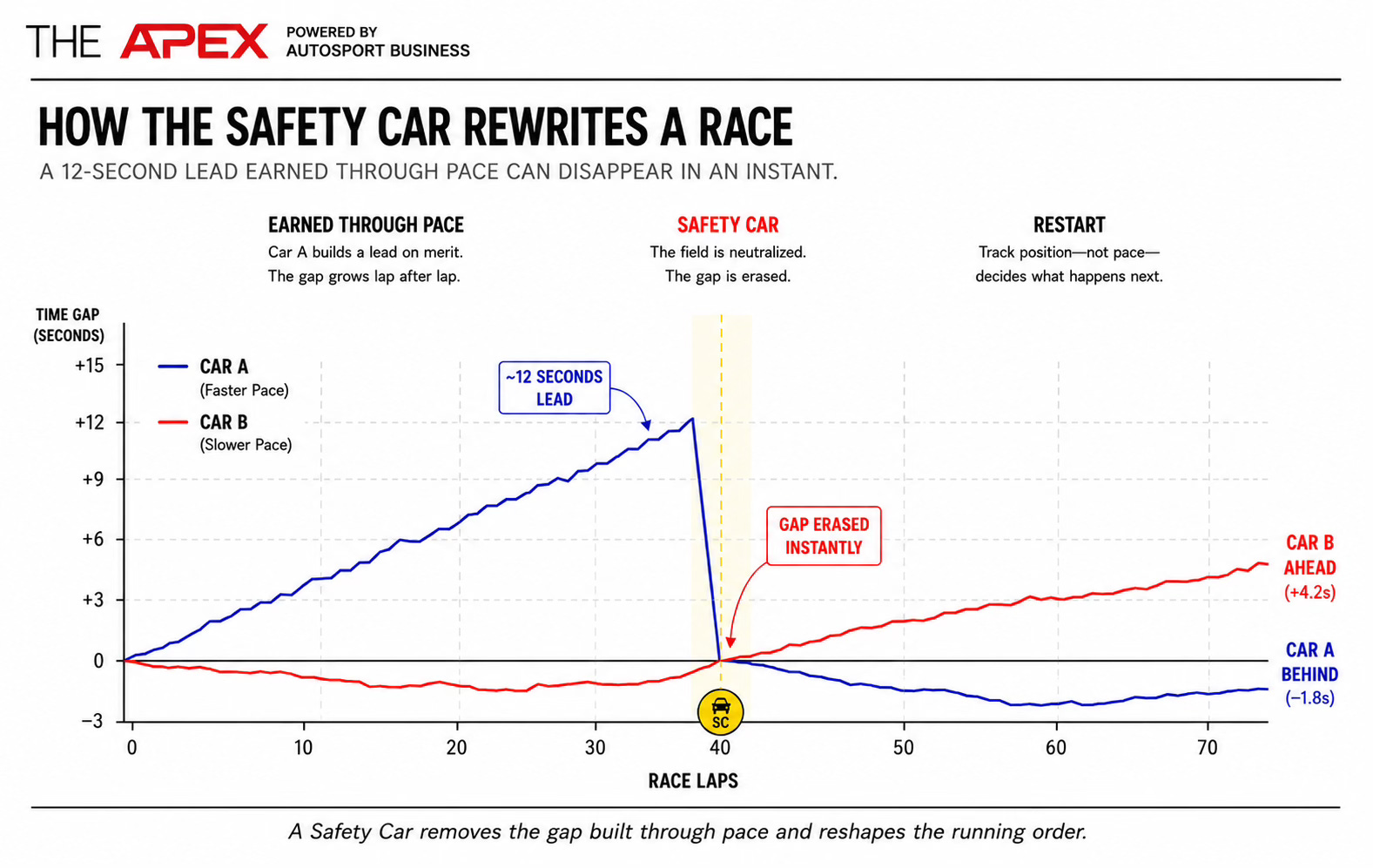
Cars that have earned a margin through pace lose that advantage as the field closes behind the leader. Time gaps disappear. Track position does not. Broadcast follows position, not truth. From that point, the race is decided by timing as opposed to speed.
A pit stop taken under a Safety Car or Virtual Safety Car can gain positions without any improvement in performance. A stop taken just before the race is neutralized can have the opposite effect, leaving a faster car behind slower traffic with no clean way forward.
That dynamic is visible in real time. When a driver drops back, the conversation turns to what might bring him back into it.
You hear it in the commentary. A driver with no way forward on pace is still in it if the race resets.
The Proof
Examples appear across eras and are consistently described as unusual. They are not unusual. They sit within how races are structured.
At the 2021 Azerbaijan Grand Prix, a late Safety Car erased the leader’s margin and forced a restart. The race was decided in two laps. The championship that year was settled by eight points. The Safety Car’s redistributive effect that afternoon was potentially worth a world title. The sponsors on the cars that lost out had no contractual recourse for what those two laps took from them.
Two laps rewrote a season. Nobody invoiced for it.
At the 2026 Miami Grand Prix, a Safety Car deployed on lap six following two separate crashes reshaped the entire field. Four cars retired. Verstappen pitted under the Safety Car, dropped to sixteenth, and recovered to fifth on strategy timing. The race he finished was not the race that existed before lap six.
Over a championship, performance tends to assert itself. Over a single race, timing can override everything built before it.
What That Means
Formula 1’s commercial system is built on finishing position.
Broadcast coverage follows track position. The cars at the front receive the most visibility, and that visibility is what sponsorship is priced against. In 2024, the sport generated two billion dollars on that assumption.
That assumption has no hedge.
Broadcast coverage is not evenly distributed across the field. Cars running at the front consistently dominate screen time, commentary, and replay. That visibility is what sponsors are buying, whether through branding, activation, or long-term association with a team.
The sport knows it. The sponsorship contracts don’t reflect it.
The scale is not abstract. A single race weekend generates tens of millions in measured sponsor exposure. The Australian Grand Prix produced $41 million in Sponsor Media Value in 2024 alone, tracked across broadcast, social, and replay coverage in sixteen countries. That figure assumes the car finishes where its pace puts it. It has no adjustment for the lap-six Safety Car.
When finishing position diverges from underlying pace, that distribution shifts with it. A team that converts timing into track position receives visibility that exceeds what its pace would support over a full race distance. Its sponsors benefit from exposure the contract did not specifically price. A faster car that loses position through the same mechanisms loses that visibility with no contractual recourse.
Two billion dollars in sponsorship. No mechanism in any of those contracts for a lap-six Safety Car.
Who Benefits
Value shifts within the race itself.
Teams that align their strategy with Safety Cars and timing windows can capture more exposure than their pace alone would deliver. A single result changes how a team is seen, how often it appears on screen, and how it is valued commercially. That effect carries across a season. Visibility compounds. A result that does not reflect underlying pace becomes the reference point for the races that follow.
The reverse is equally true and equally unpriced. Teams that show strong pace without converting it into position lose exposure at the point where it matters most, with no mechanism in their sponsorship agreements for what the timing window took from them.
Formula 1 has known this for thirty years. The contracts have never reflected it.
In 2026, with the most volatile grid in recent memory, the gap between what sponsors are buying and what the Safety Car can redistribute has never been larger. The sport calls it randomness. The market treats it like pricing error.